
What is AI & Machine Learning?
What is Artificial Intelligence (AI)?
Artificial Intelligence, or AI, is the ability of computers to perform tasks that typically require human intelligence. Think about all the things your brain does — recognizing faces, understanding speech, making decisions, translating languages, driving a car. AI is about teaching machines to do these things.
But let’s be clear: AI in 2026 is not like the robots you see in science fiction movies. Current AI is what we call “Narrow AI” or “Weak AI” — it’s designed to perform specific tasks very well, but it can’t think, feel, or understand the world like humans do. When ChatGPT writes an essay or Google Translate converts Hindi to English, that’s AI at work — impressive, but limited to specific functions.
Real-World Examples of AI You Use Every Day
You probably interact with AI dozens of times a day without realizing it:
- Google Search: AI understands your query and returns the most relevant results.
- YouTube/Netflix Recommendations: AI analyzes your viewing history to suggest content you’ll enjoy.
- Voice Assistants: Alexa, Siri, and Google Assistant use AI to understand and respond to your voice.
- Social Media Feeds: Instagram and Facebook use AI to curate your feed based on your interests.
- Spam Filters: Gmail’s spam filter uses AI to identify and block unwanted emails.
- Navigation: Google Maps uses AI to predict traffic and suggest the fastest route.
- Online Shopping: Amazon’s product recommendations are powered by AI.
- Face Unlock: Your phone uses AI to recognize your face.
What is Machine Learning (ML)?
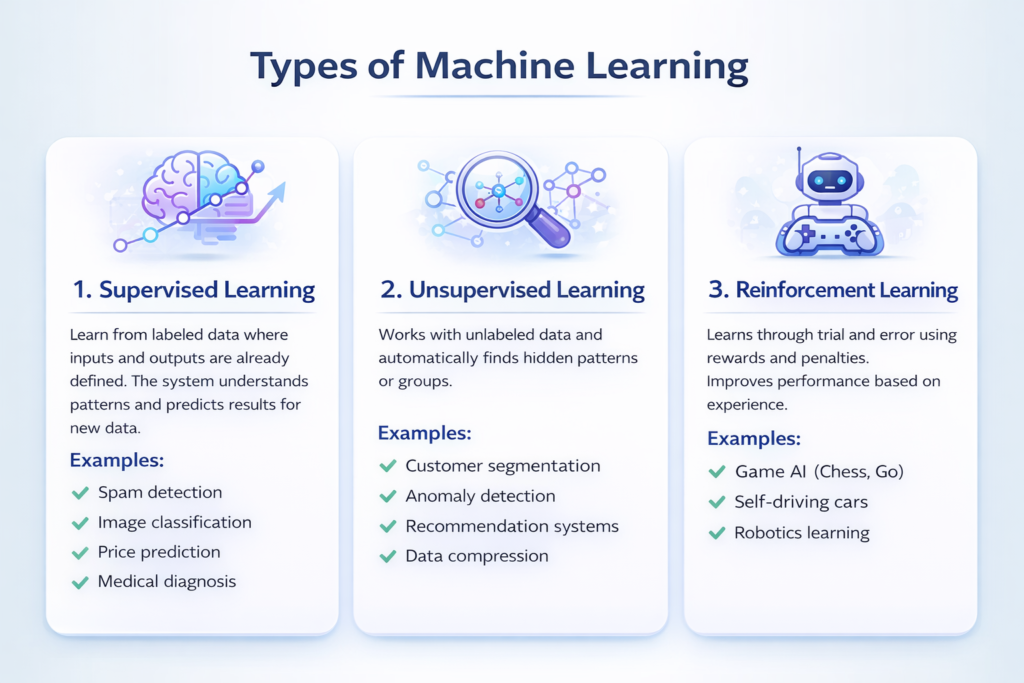
Machine Learning is a subset of AI. While traditional programming involves giving a computer explicit instructions (“if this, then do that”), machine learning takes a different approach: you give the computer data and let it learn patterns on its own.
Think of it this way: Traditional programming is like giving someone a recipe. Machine learning is like showing someone thousands of cakes and letting them figure out how to bake one themselves by recognizing patterns in what makes a good cake.
A Simple Example
Let’s say you want to build a spam email detector:
- Traditional Programming: You manually write rules — “if email contains ‘free money,’ mark as spam; if sender is unknown, mark as spam.” This requires you to think of every possible rule, which is impractical.
- Machine Learning: You feed the system thousands of emails labeled as “spam” or “not spam.” The ML algorithm learns patterns — certain words, sender patterns, formatting styles — that distinguish spam from legitimate emails. It can then classify new, unseen emails automatically.
What is Deep Learning?
Deep Learning is a specialized subset of machine learning that uses neural networks — computing systems inspired by the human brain’s structure. These networks have multiple layers (hence “deep”) that process information at increasingly complex levels.
Deep learning powers the most impressive AI applications: ChatGPT and other language models (understanding and generating text), image recognition (identifying objects, faces, scenes), voice recognition (converting speech to text), self-driving cars (processing visual information from cameras), and art generation (DALL-E, Midjourney, Stable Diffusion).
AI vs Machine Learning vs Deep Learning: What's the Difference?
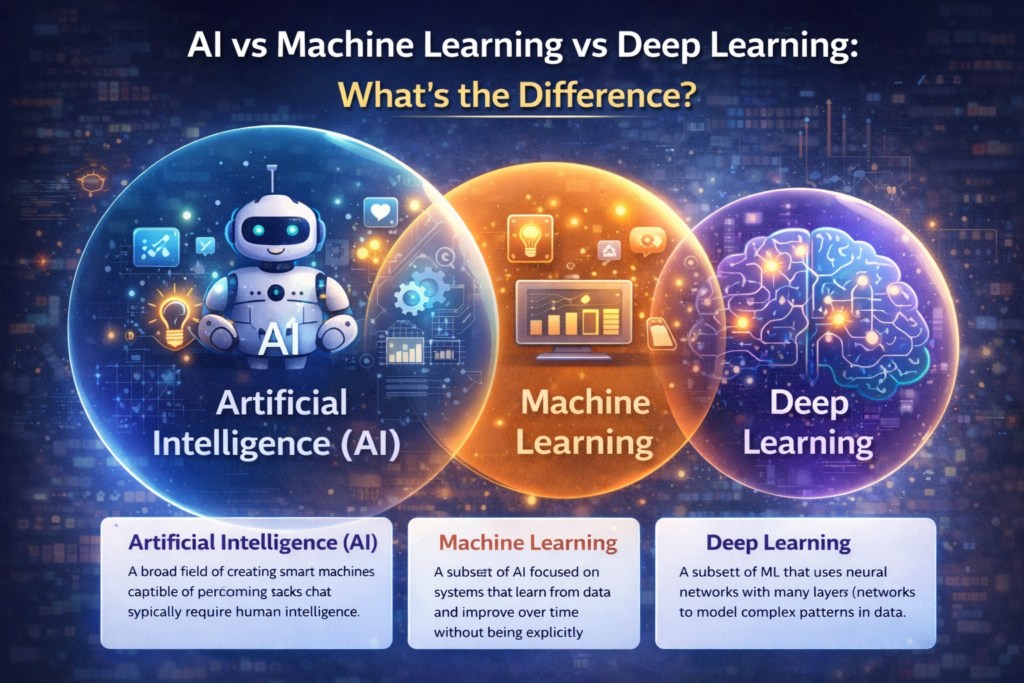
Think of them as nested circles: AI is the broadest concept — any technique that enables computers to mimic human intelligence. Machine Learning is a subset of AI — algorithms that learn from data without explicit programming. Deep Learning is a subset of ML — using neural networks with many layers for complex pattern recognition.
How to Get Started with AI/ML
If you’re interested in learning AI and ML, here’s a roadmap:
- Learn Python: Python is the primary language for AI/ML. Master the basics first.
- Learn Mathematics: Linear algebra, statistics, probability, and calculus form the foundation of ML algorithms.
- Learn Data Manipulation: Master Pandas and NumPy for data processing.
- Learn ML Fundamentals: Understand different algorithms, when to use them, and how to evaluate them. Andrew Ng’s Machine Learning course on Coursera is the gold standard.
- Practice with Real Data: Use Kaggle for datasets and competitions. Build projects that solve real problems.
- Learn Deep Learning: Once comfortable with ML basics, explore neural networks using TensorFlow or PyTorch.
Career Opportunities in AI/ML
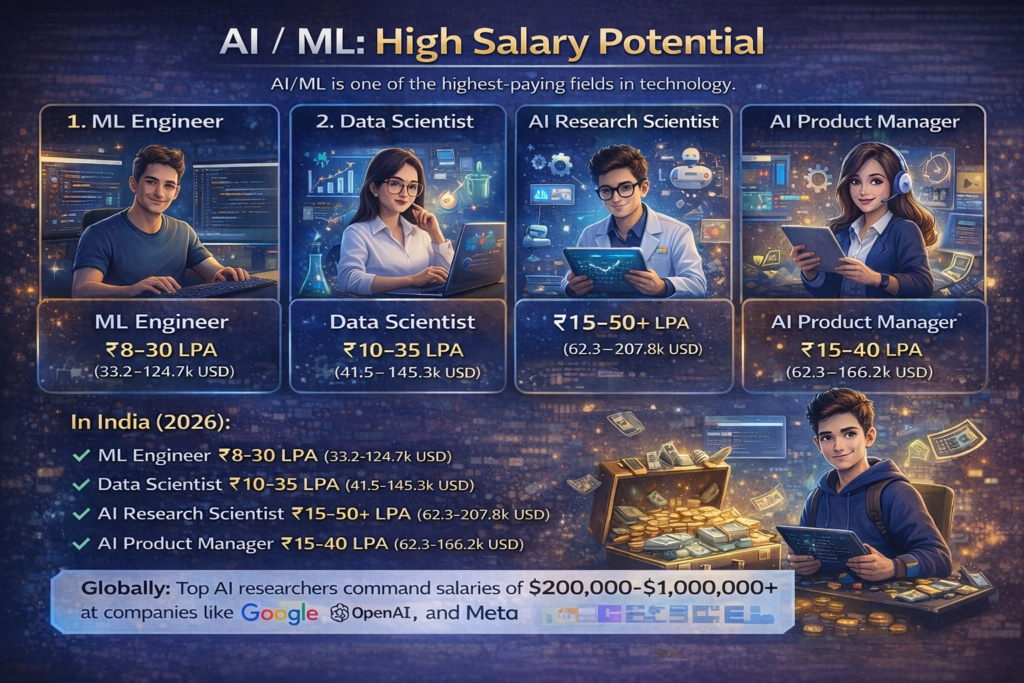
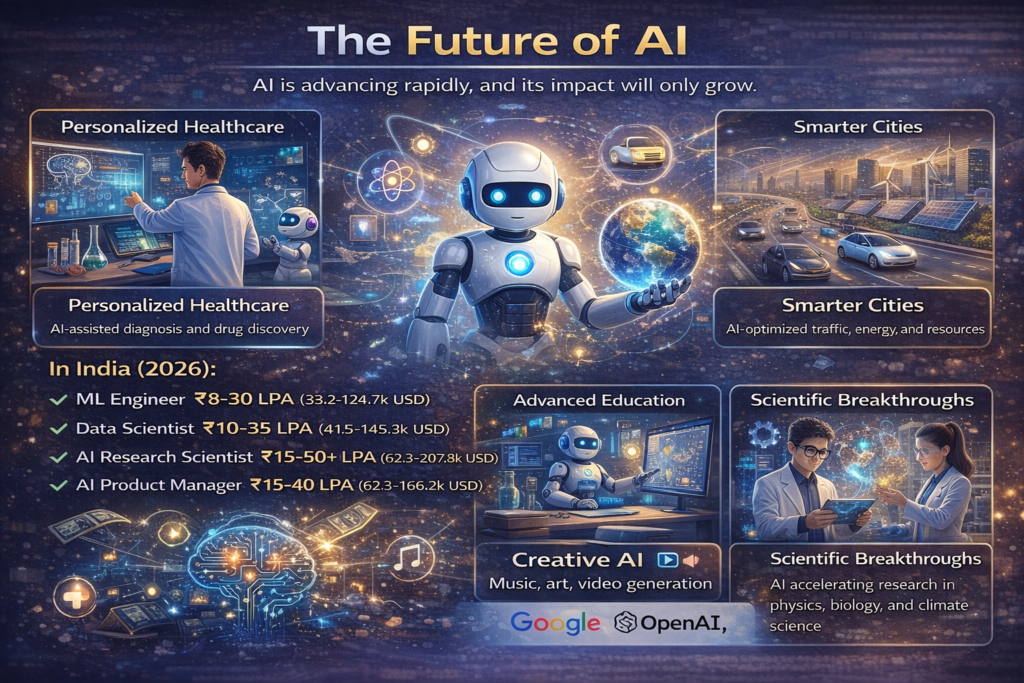
AI/ML is one of the highest-paying fields in technology. In India (2026): ML Engineer (₹8-30 LPA), Data Scientist (₹10-35 LPA), AI Research Scientist (₹15-50+ LPA), AI Product Manager (₹15-40 LPA). Globally, top AI researchers command salaries of $200,000-$1,000,000+ at companies like Google, OpenAI, and Meta.
The Future of AI
AI is advancing rapidly, and its impact will only grow. We’ll see more personalized healthcare (AI-assisted diagnosis and drug discovery), smarter cities (AI-optimized traffic, energy, and resources), advanced education (personalized learning paths), creative AI (music, art, video generation), and scientific breakthroughs (AI accelerating research in physics, biology, and climate science).
Conclusion
AI and Machine Learning are not futuristic concepts — they’re the present reality. Understanding these technologies, even at a basic level, is valuable regardless of your career path. Whether you want to become an AI engineer or simply understand how the technology works, taking the first step in learning about AI/ML is a smart investment in your future. The field is still young, opportunities are abundant, and the journey is fascinating.